
JD Sports - My Account
- WISMO contacts
- Down 12%, against an 8% target
- In-store returns
- 31% used the new QR kiosk flow
- Contact volume
- ~3,600 fewer contacts a month
- Accessibility
- 98% WCAG 2.1 compliance
How this came about
Nobody assigned this. I decided the timing was right.
The replatform kicked off a wave of initiatives to rebuild the site. My Account was always on that list, the business just never gave it priority. It had been raised before, but the old stack made it too costly to fix properly, so it kept losing out to work with a clearer return.
WISMO kept showing up in the CS email reports, tens of thousands of contacts a month, consistently the highest volume driver. Returns was the second-highest driver in the same data.
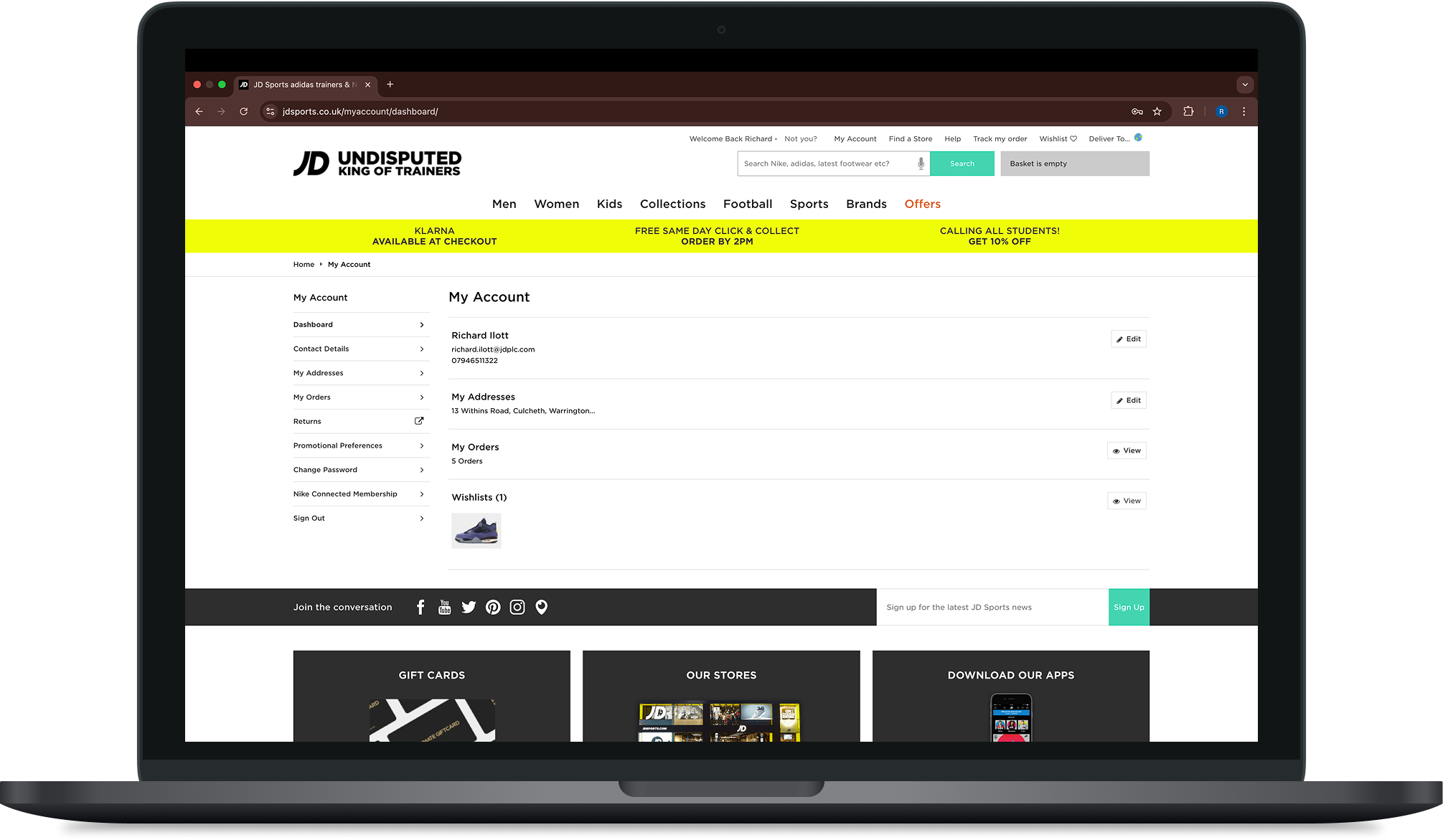
I pulled the GA data on link clicks inside My Account. My Orders was the clear leader. Nike Connected barely got touched.
Speaking to the CS lead, the cause turned out to be technical: order status regularly stalled at "on its way," and tracking links dropped customers into a manual carrier lookup. Fixing the status updates themselves was clearly going to be as much a part of this as the IA.
The PM agreed it mattered, and had a genuine open question about whether this was really an IA problem at all rather than something else — a fair instinct at that point, not pushback, and one the research would go on to answer either way. The business hadn't agreed it was urgent, weighted toward conversion, not operational cost.
I set the target directly with the CS lead and trade director, not handed down: 8% fewer WISMO contacts, benchmarked against industry standard and weighted against our own contact data.
Before any workstream was scoped, we settled who owned what: PM held prioritisation and the business case, CS lead held the data and definition of done, I held the design and evidence work. That split, plus the 8% target, became the brief the four workstreams were built against.
The shape of the project
Four workstreams, not one IA tweak.
Workstream 1 — IA Restructure: Rebuilt the account navigation around real usage data and card-sort findings.
Workstream 2 — Delivery Accuracy: Selected and implemented Narvar to fix the status itself, not just where it lived.
Workstream 3 — In-Store Returns: Second-highest CS contact driver in the same data as WISMO. Run in parallel with its own squad — PM, BA, TPO and engineering from the in-store team — with the same CS lead connecting both workstreams.
Workstream 4 — Future-Vision Concepts: Explored and tested four concepts with the business, covering wallet functionality, gamification, and top spend. Detail below.
Not a content problem
The assumption in play: a content fix felt obvious. Nobody had questioned the structure itself.
What I found: the information customers needed already existed on the old My Account. The problem was structural, not visible — the ongoing replatform opened a technical window to actually fix it.
Making it stick
Acknowledged isn't the same as prioritised.
Partnered with the PM and CS lead to take it to the business as a severe operational risk, framed around contact cost and eroded trust, not as a nice-to-have.
Acknowledged became prioritised. Brought in BA, TPO and tech lead next.
Working with procurement, compared suppliers already on the table against what CS actually needed. Narvar came out ahead on tracking accuracy. Three workstreams landed together: IA fixed where to find the status, Narvar fixed whether it was true, and returns closed the gap in-store.
Making the case with evidence
A card sort tested the mental model directly.
The mid-weight designer I was mentoring at the time ran the competitor review, ten sites, nearly all led with orders and returns. I reviewed CS data and ran a card sort to test the mental model directly.
Result: order tracking, returns and delivery grouped unambiguously at the top. Accessibility was tested at the same stage, not bolted on after — labelling, grouping and tab order were checked against WCAG alongside the mental-model testing.
The research didn't confirm the existing structure. CS wanted a content fix. The research argued against that too.
Hierarchy A/B tested for click-through pre-launch. Contact volume was the real-world result, tracked after.
Narvar implementation
Selected for accuracy, designed to actually show it.
The selection: sat in supplier reviews with procurement. Weighed what was on the table against what CS actually needed. Narvar came out ahead on tracking accuracy.
What I designed: replaced the stalled "on its way" with two clear states, Processing and Delivered, each showing an estimated delivery date pulled straight from Narvar. Worked with the internal Narvar team to map delivery and returns statuses and get the wording right for customers. Status colour-coding was checked against WCAG contrast requirements as each state was designed, not left to a single audit pass later.
Also shaped the content in Narvar's order emails and texts, working with Content and a copywriter alongside CRM to keep every touchpoint joined up.
Returns, in store
Online got IA. In store needed something else.
The problem: no easy path for in-store returns. Having to be logged into their account to have their order number to show. Typical complaints were paying to return through post or lockers, and long queues in-store.
What I built: ran this alongside WISMO with a separate squad — PM, BA, TPO and engineering from the in-store team — with the same CS lead connecting both workstreams.
Working with the in-store team, found the return kiosks were already technically set up for QR-code returns — the capability existed, the experience didn't.
Designed the flow: a return pass that could be added to a device wallet, scanned at the kiosk, product left in the drawer underneath. No queue, no locker fee.
Narvar's CRM layer, already shaping WISMO's order emails and texts, also had to power the wallet-pass links for returns. Worked across both squads to get Apple and Google Wallet integration into the email flow, so the same infrastructure served both workstreams.
Future-vision concepts
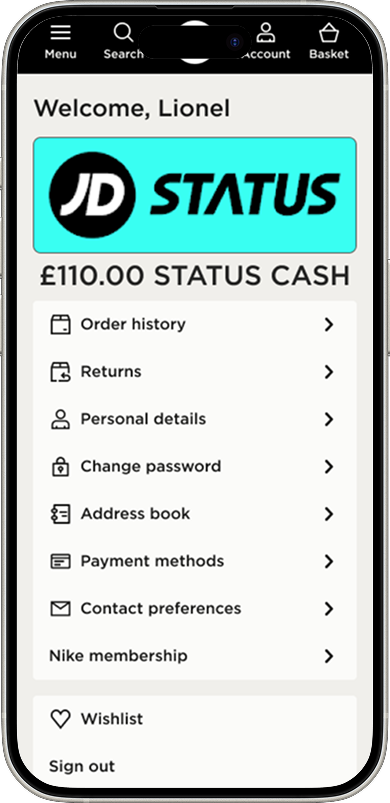
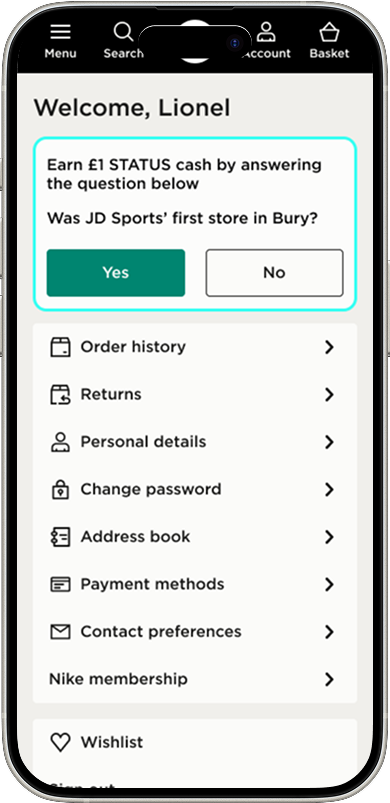
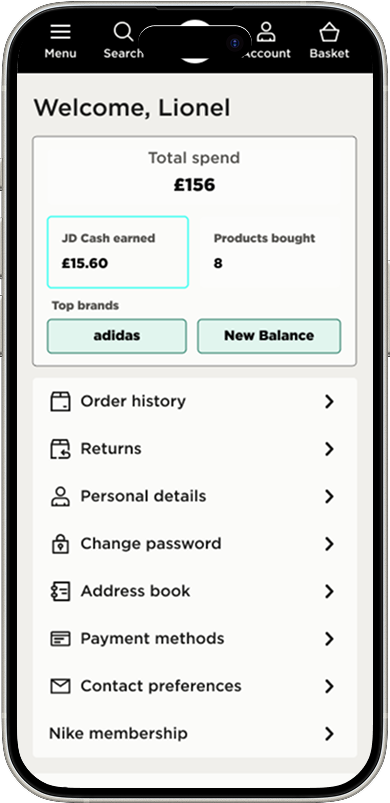
Four concepts came out of an ideation workshop with design, PM, CS and Content, then a vote: a Status cash balance banner, total spend and top brands, gamification, and a wallet concept centred on saved payment methods and parent-child linked accounts. Three were shown as screens and tested with 100 customers over 24 hours; the wallet concept was tested by hypothesis rather than a shown screen.
The results were mixed rather than a clean win or rejection. Status cash was well received but customers were confused they couldn't spend it online — a limitation traced back to engineering cost and the STATUS team's in-store-only view, and still the case as of my leaving. Top Brands worked; the raw spend figure next to it caused unease and risked suppressing purchases, so it didn't proceed. Gamification tested well for engagement but customers didn't see My Account as the right place for it — it did, however, lead to the trade director asking me to prototype an Adidas gamification pitch separately.
The wallet concept split the research: some customers wanted parent-child linked accounts for exactly the reason I'd hoped, control and independence for a teenager's spending. Others didn't want to hand JD their savings interest, which killed the full wallet ambition. What survived that split was the smaller, provable piece: saved payment methods, removing friction from repeat purchases. I'd seen the same pattern hold at Flutter — wallets cut time-to-bet there — and judged the parallel held here too, even though betting is more regulated and faster-paced. The business agreed to trial it. That's what shipped.
What shipped
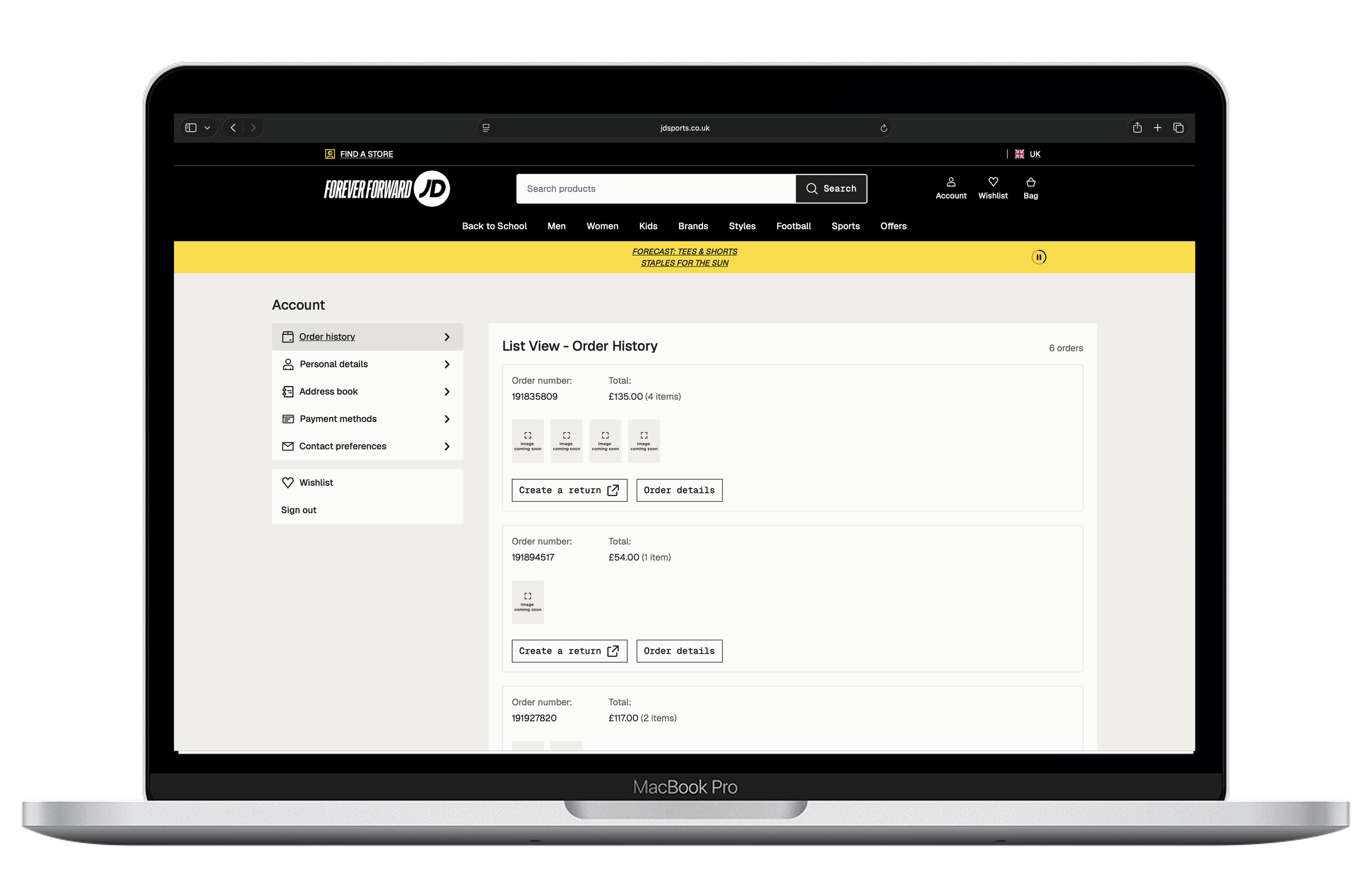
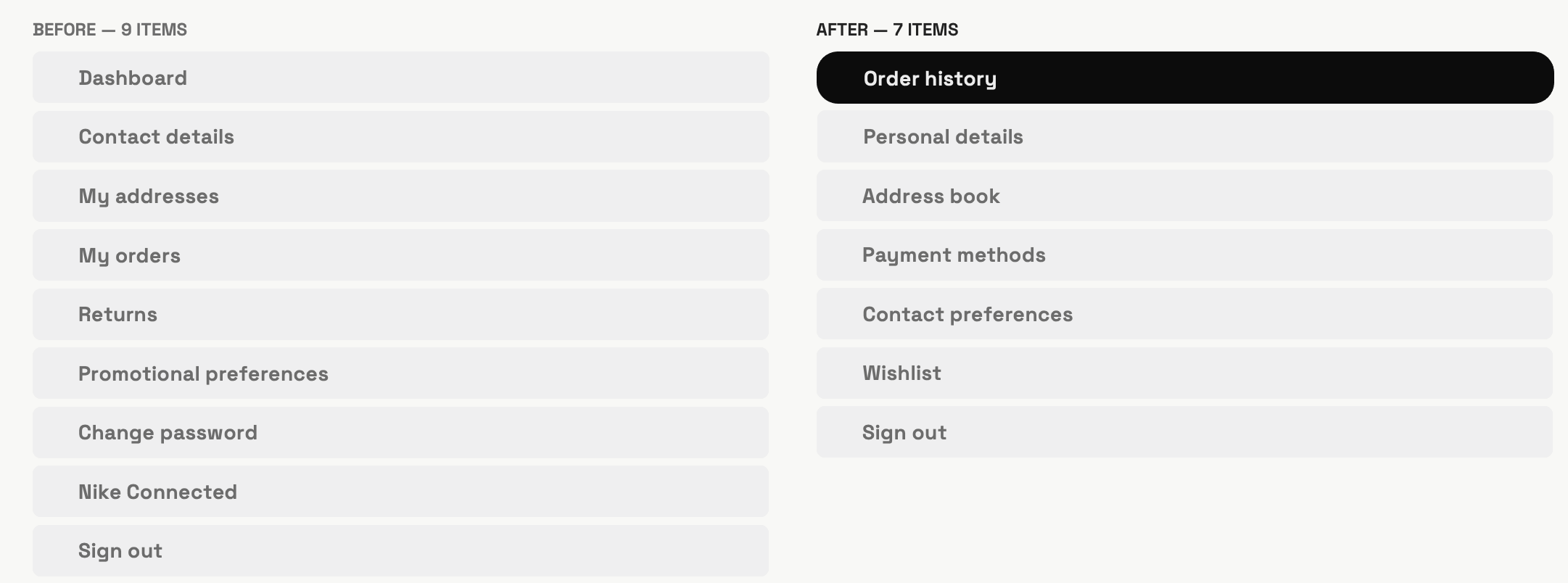
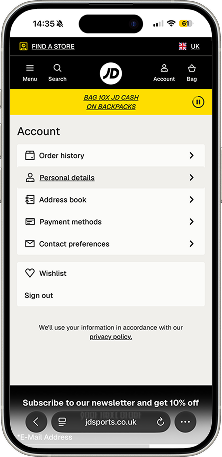
Restructured around the card sort findings, not just reordered.
Dashboard removed, no perceived value, inconsistent across platforms. Returns folded into Order History, tested via a tree test. Payment methods added, quicker saved-card checkout. Nike Connected set aside, trade and the Nike partnership team's call, not mine.
Also moved to a unified responsive build, one domain, replacing what had been split mobile and desktop URLs.
These designs sit inside a design system co-built with my previous manager, roughly a 60/40 split — mine: components, codified and documented with Liam. Before this, every squad rebuilt UI patterns from scratch; the design system became the shared reference other designers built and documented against.
Those in-flight checks were confirmed at the end by our accessibility consultant, 98% for WCAG 2.1, a validation of the thread running through the project, not a single audit pass.
This shipped in the UK, Ireland and Italy by the time I left, with another 9 European markets planned for rollout later in 2026.
Engineering, through a reshuffle
JD had just sold its engineering function to a third party. My old contacts were gone.
I brought the new tech lead in early, data, findings, designs, before a single ticket.
Even through the reshuffle, the squads managed to get these projects defined, designed and built inside two months.
Mentoring in the gap
When this project kicked off, my manager had gone off sick — I covered as acting head of design for five months, running the function while this project shipped underneath it.
I prioritised the team's work across all live projects, not just this one, ran 1:1s and PDPs, and presented updates to SLT in my manager's place.
Two new mid-weight designers joined the team during that time, and I brought each of them onto this project at different points to shadow me and bounce ideas off throughout — early exposure to a live, high-stakes piece of work and to Built to Repeat, my design process, and a chance for me to properly assess their capability while resourcing was tight.
Held the two-squad structure — My Account and in-store returns — together through this period myself; both PMs, BAs and TPOs kept moving, I was the constant thread across both.
The success of this project owes a lot to them.
What we didn't get
An honest trade-off, not a polished win.
My Account sits behind "More…" on iOS and Android. I pushed to elevate it.
Due to the data breach, the replatform was the security response, every function resourced against it. The app was ugly, but secure; web wasn't.
Monthly product forums put me in the room with SLT. Most months, the app trade managers pushed for investment and got shut down. Not my call to make, but watching that pattern told me not to spend more effort pushing it.
Fewer contacts, fewer failures
-12% WISMO contacts (target -8%)
+31% In-store returns via QR kiosk
~3,600 Fewer contacts / month
~30,000 WISMO contacts a month, pre-launch, dropping by roughly 3,600 a month post-launch.
IA fixed discoverability, could a customer find the status. Narvar fixed accuracy, was the status true. Both landed in the same window, so the 12% result is a stable baseline for the combined change, not a figure I can cleanly split between the two workstreams. I'd rather say that plainly than invent a split.
What I'd do differently
Measure retention, not just adoption. Saved payment methods launched to real uptake, but I only measured whether people used it. I never built in the comparison that actually mattered — did those customers order more often afterwards. Next time that measurement goes in from day one, not as an afterthought.
Hand supplier evaluation to procurement sooner. I sat in three supplier meetings weighing what could be delivered — interesting from a design seat, but procurement was better placed to run it. I'd hand it off earlier and put that time into the in-store returns workstream, which was already stretching thin alongside everything else.
What this actually was
Not an IA tidy-up. A body of work.
Kept leading the replatform and its design system throughout, this ran alongside that, not instead of it.
One flat number in a CS report became an audit, a procurement decision, a returns fix nobody had built, and a shipped IA restructure across three markets.
A relationship-building exercise with new members of the team at a time of immense team flux.