
JD Sports - Product Customisation
Context
The brief was to improve it. My job was to understand what improvement actually required.
Product customisation — adding names, numbers, and badges to football shirts — was already live on the JD Sports site. It worked poorly. The experience was functional in the narrowest sense, and commercial performance reflected that.
Before forming a view on what improvement required, I ran a structured competitor analysis to understand how the market was solving the same problem. That research came first. It changed everything that followed
Research Approach
Using AI to understand the market before committing to a direction.
To avoid committing to a direction based on assumption, I used a structured prompt framework to analyse how seven competitors across different sports and markets handle the visualisation and confidence problem in customisation. The prompt was built using the competitor analysis framework from my book, Designing with AI: Prompt Thinking for Product Designers.
Competitors reviewed: Nike, Adidas, Kitbag, Spized, Sports Direct, New York Yankees, and the Indian Premier League. The breadth was deliberate — football, baseball, and cricket operate under different licensing constraints and have found different solutions to the same underlying problem.
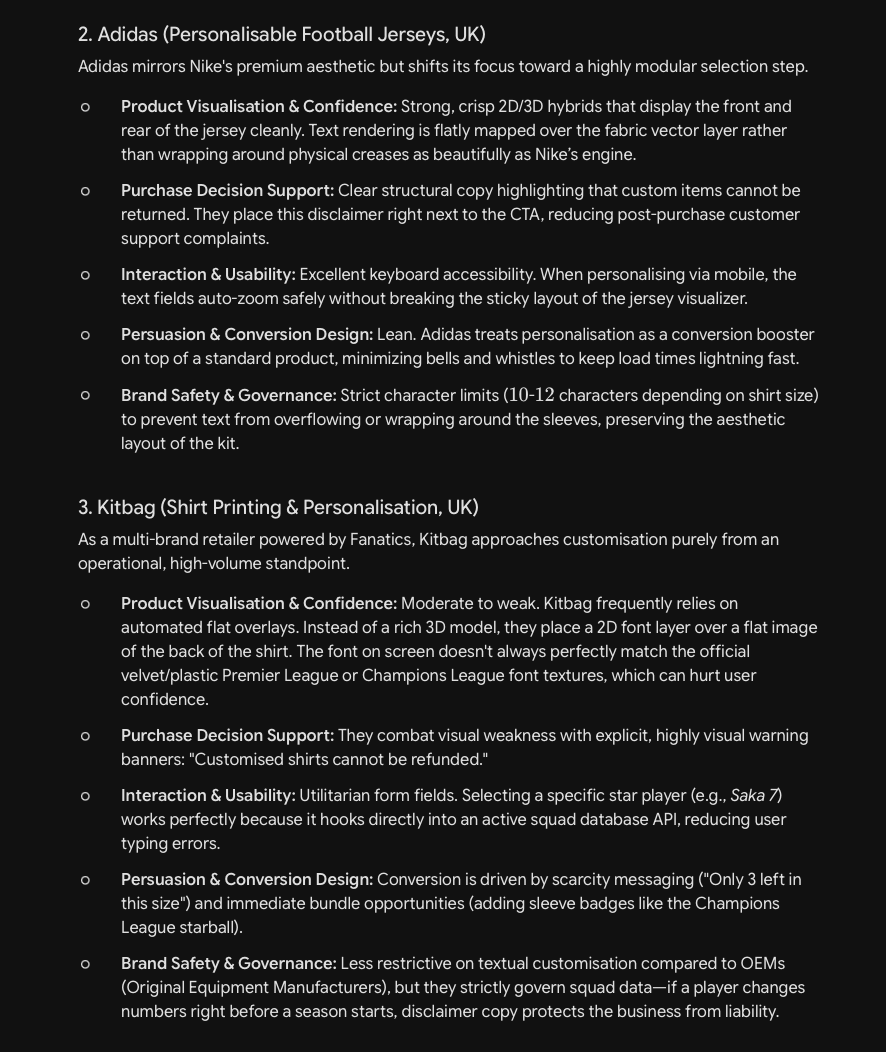
The output revealed a consistent market pattern: visualisation quality tracks market type, not brand size. The largest brands deliver the weakest visualisation for shirts. No licensed retailer in the set had implemented a mandatory confirmation screen before a non-returnable purchase. The confirmation gap was universal.
[IMAGE 2 — Screenshot of the cross-market patterns section and the confirmation gap finding from the AI output. Crop to the most relevant paragraphs — "Cross-Market Patterns" through to "The confirmation gap is universal."]
That finding directly informed the reframe that followed.
The Real Problem — Confidence, Not Capability
The existing JD experience had a capability problem. The user interface was limited and confusing. Underneath that was a confidence problem: customers could not see what the finished product would actually look like. Fixing the user interface without addressing the confidence gap would improve the experience superficially without solving what was driving abandonment.
The competitor analysis confirmed this was not a JD-specific problem. Every major licensed retailer in the market had the same gap. The opportunity was to solve it properly.
[IMAGE 3 — Existing JD customisation experience before the redesign. Product page screenshot or wireframe showing the original state — the functional but poor experience referenced in the brief.]
Stakeholder Resistance — Merch and Studio
The direction I proposed — improving product visualisation to show a realistic representation of the customised shirt — was challenged by Merchandising and Studio. Their concern was operational: every combination of shirt, colour, and customisation option would need either high-quality photography or a credible rendering solution, and the production effort felt disproportionate to the likely return.
I evaluated three options: generic mockups, real product photography at scale, and live rendering. The rendering approach resolved the operational objection. A rendering solution could apply customisation options to a base product image dynamically, reducing the production requirement to a single high-quality base shot per shirt. I presented that reframe to Merch and Studio, and the conversation shifted from production effort to rendering quality. The product manager and Engineering co-owned the technical execution from that point.
[IMAGE 4 — The three options evaluated side by side if you have them. Alternatively a flow diagram or decision framework showing generic mockup vs photography at scale vs rendering, with rendering marked as the chosen direction and the reason why.]
Brand Safety — A Governance Problem
Open-text customisation introduced a brand safety problem the original brief had not addressed. Brand partners like Nike, Adidas, and Puma had a direct stake in what appeared on their products. A shirt with an offensive message sold through JD would carry the brand partner's branding as visibly as JD's, making this a relationship risk, not just a moderation problem.
I developed a governance framework in collaboration with Distribution Centre managers, Trade, Merchandising, and brand partner contacts. The framework established a profanity filter, a brand partner-maintained restricted word list, and an escalation process for edge cases. Distribution Centre managers were involved because they were the operational endpoint — the point at which a customised order either ships or gets flagged. The product manager and Engineering co-owned the implementation.
The framework also introduced a friction point at the point of customisation: a clear acknowledgement that customised items cannot be returned. That friction was intentional. It created a moment of consideration that reduced both inappropriate customisation attempts and post-purchase return requests.
[IMAGE 5 — The governance framework as a visual artefact. A flow diagram showing the order journey from customer input through profanity filter, brand partner restricted word list, escalation process, through to Distribution Centre dispatch or flag. If you have a Figma or Miro version of this, use it. If not, this is worth creating as a simple diagram — it's one of the strongest outputs in the case study.]
[IMAGE 6 — The returns acknowledgement friction point in the user interface. The screen or component where the customer confirms customised items cannot be returned. Show the designed state, not a wireframe if possible.]
What Didn't Get Built
The original vision included a real-time product preview updating as the customer made choices. Engineering confirmed the technical complexity and timeline sat outside the project scope. I deferred it to the roadmap. The governance framework and rendering approach are in place. The real-time preview is a sequencing decision, not a strategic one.
Outcome
Return-related contacts for customised orders decreased after the returns acknowledgement friction point went live. That is a direct result of a deliberate behavioural design decision, not a process change.
The revenue outcome is tied to the World Cup trading window. Kit customisation demand peaks around major international tournaments and full commercial validation will follow that cycle. The structural work is complete and the platform is ready for it. The immediate outcome is organisational: this project created the brand safety infrastructure and the visualisation standard that make customisation commercially viable at scale. That work had to happen before the revenue could follow.
What This Changed Organisationally
Brand safety governance framework established across Distribution, Trade, Merchandising, and brand partners, with operational process aligned end to end before full launch.
Rendering approach defined as the standard for product visualisation in customisation, removing the dependency on per-combination photography.
Returns acknowledgement friction point introduced as a standing design decision, reducing post-purchase contact volume on customised orders.