
JD Sports - Product Customisation
- Return contacts
- Down 48% after the confirmation modal shipped
- Adoption
- Up 30% vs. Euro 2024, same period
- Touchpoints unified
- 9 touchpoints carrying consistent logic
- Retailers benchmarked
- 7, in the competitive analysis
Context
Product customisation, adding names, numbers and badges to football shirts, was already live on the JD Sports site. It worked poorly. The experience was functional in the narrowest sense and commercial performance reflected that. The brief was to improve it. My job was to work out what improvement actually required before committing to a direction.
I ran this alongside a PM, Engineering, Merchandising, Studio, Distribution Centre managers, Trade, and brand partner contacts at Nike, Adidas and Puma. Design took four weeks including time waiting on Merch and Studio sign-off, followed by two weeks of engineering build and one week of testing and QA.
The real problem: confidence, not capability
92% of shirt orders are for official squad players. Customers were typing names the business already held accurate data for into a free text field, with no way to check the result.
I ran an AI-assisted competitive analysis across seven retailers: Nike, Adidas, Kitbag, Spized, Sports Direct, MLB Shop and the Indian Premier League official stores. AI did the synthesis, pulling the pattern out of seven disconnected experiences fast enough to be useful inside the timeline.
The pattern was consistent. The experiences that performed best were built around visualisation confidence, not capability. Nike By You runs a 3D footwear configurator. Spized runs a real-time kit designer. Sports Direct MYiD updates preview imagery live.
Kitbag is the industry leader in football shirt sales and offers no preview at all. Customers commit to a non-returnable product without seeing what they are buying.
JD had a capability problem. The UI was limited and confusing. Underneath it sat a confidence problem. Customers could not see what the finished product would look like before committing to something they could not return. Fixing the UI alone would have improved the surface and left the cause in place.
Stakeholder resistance: Merch and Studio
The direction I proposed, showing a realistic representation of the customised shirt, was challenged by Merchandising and Studio. Their concern was operational. Every combination of shirt, colour and customisation option would need either high-quality photography or a credible rendering solution, and the production effort felt disproportionate to the likely return.
I organised two trips myself. One to the Distribution Centre, with the PM, BA and technical product owner, to see how customisation was actually printed. One to JD's Trafford Centre store, to speak with customers directly — an intern I was mentoring at the time came with me, shadowing the session and asking questions, though the sketch-level exploration that came out of it was as far as their hands-on involvement went.
I validated in store at Trafford Centre with five customers, who compared their purchase against a Figma prototype. Speed and print-accuracy concerns both came back — the same concerns the Distribution Centre visit later confirmed from the operational side.
I got the working group into a room for ninety minutes, presented the competitive analysis directly, and put three options on the table.
Exact product images. Every product shown with real authentic customisation. The best result, and a photography requirement across the full range.
Key product images. Example imagery for each option, applied across products. Cheaper, and it carried a specific failure: a Nike product appearing on an Adidas product page.
Generic product images. Rendering applied to generic imagery, showing the customer how the printing will look, curved or straight, without matching the shirt exactly.
I also put forward my own preferred direction, a real-time preview updating as the customer made choices, as the standard worth aiming for. I did not expect it to be feasible inside scope.
We worked through the man-hours each option would realistically take as a group, and identified that our Gemini partnership could speed up production for the generic-imagery option by generating base assets rather than requiring a full photography run. Rendering reduced the requirement to a single high-quality base shot per product.
That resolved the objection. The conversation moved from production effort to agreeing rendering quality standards, and PM and Engineering co-owned the technical execution from there.
Brand safety: a governance problem
Open-text customisation introduced a brand safety problem the original brief had not addressed. Nike, Adidas and Puma have a direct stake in what appears on their products. A shirt carrying an offensive message through JD carries the brand partner's branding as visibly as JD's. That makes it a relationship risk, not a moderation task.
At the Distribution Centre, I found that whether a banned or offensive word got printed came down to individual worker discretion on the print floor. There was no systematic check. Whoever was working the line decided in the moment whether something looked wrong. That gap was not visible from anywhere else in the process, and it is the reason the governance framework could not be a front-end input filter.
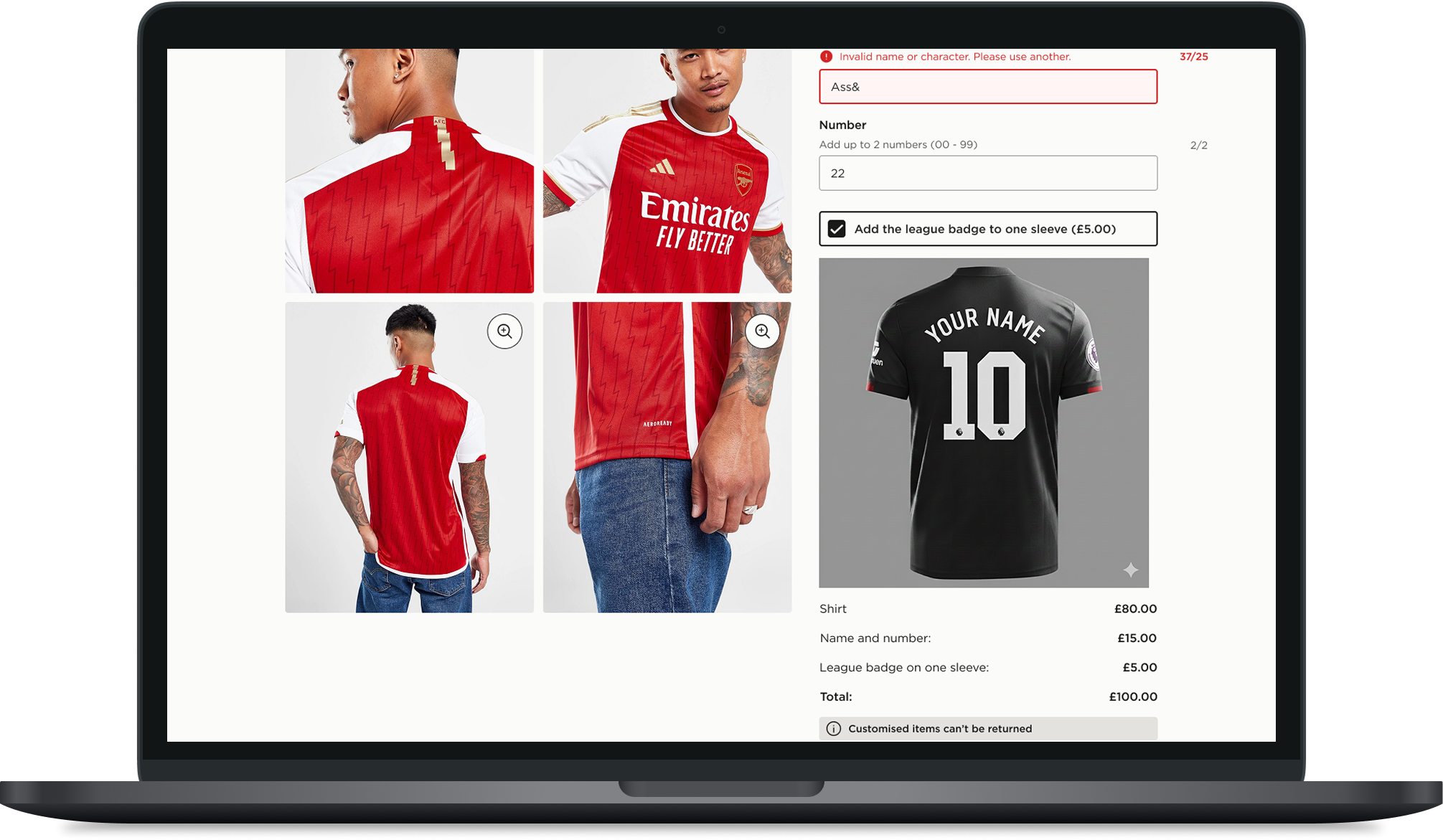
I built the framework with Distribution Centre managers, Trade, Merchandising and brand partner contacts. It established a profanity filter, a brand partner-maintained restricted word list, and an escalation process for edge cases. The restricted word list now lives on the distribution centre's own system as a formal intake step, replacing individual worker judgement with a consistent check — something I saw working directly: as customisation prepared to launch in France, the local copywriter was feeding new banned words into that same list. DC managers were involved because they were the operational endpoint, the point at which a customised order either ships or gets flagged. PM and Engineering co-owned the implementation.
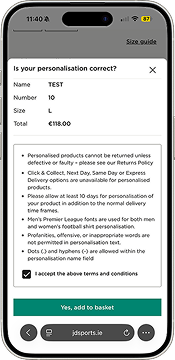
The framework also introduced a friction point at the moment of commitment: a confirmation modal restating the personalisation, the price, and the terms that apply to it. Personalised products cannot be returned unless faulty. Express and Click and Collect delivery options are unavailable. Production takes at least ten days on top of standard delivery. That friction was aimed at a specific, named problem, reducing contacts from customers who had not realised personalised items were final. It was not friction for its own sake. Content and a copywriter helped get that wording right — clear enough to actually change behaviour, without reading as a legal notice.
Eight touchpoints, one flow
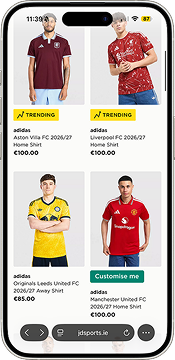
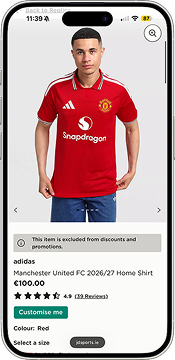
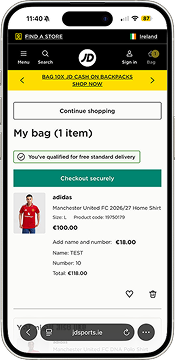
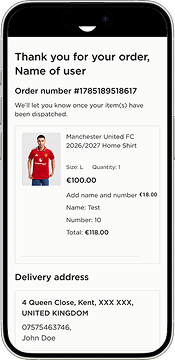
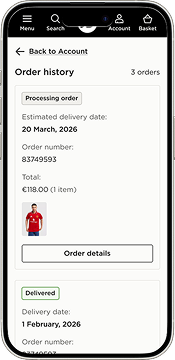
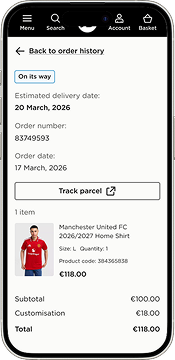
This was not a single-screen fix. The personalisation journey runs across eight touchpoints: browse and discover, product page, personalise and validate, confirm terms, bag, checkout, confirmation, order history, and order details. Each one carries the customisation and governance logic through consistently, rather than treating personalisation as a step bolted onto standard checkout.
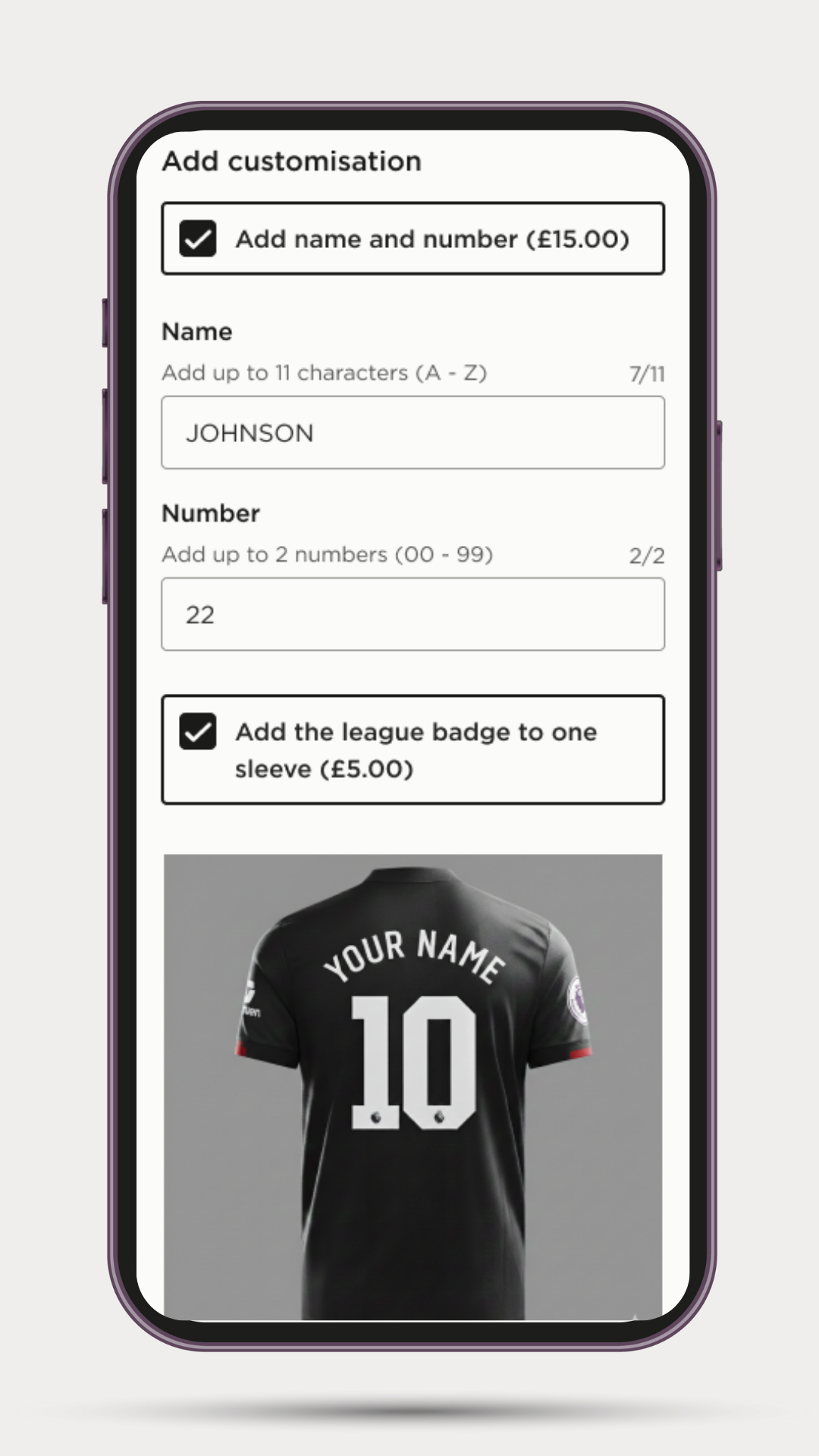
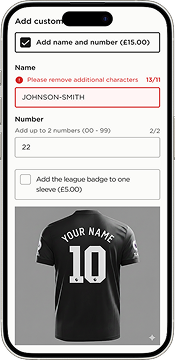
The preview is the clearest example of turning a minimum-viable input into something that earns trust. The original approach asked customers to trust a plain text field. The shipped version renders their name and number so they can see how the printing will look, built jointly with Engineering, Merchandising and Studio. Invalid entries are rejected immediately with a clear error rather than being silently caught later by whoever is working the print floor.
Constraints are stated where they apply rather than in terms. Men's Premier League fonts are used on both men's and women's shirts, so the personalise screen says so at the point a customer is choosing.
What the preview does, and what it does not
The shipped preview renders a representation of the printing on an inaccurate garment. A customer sees a generic "Your Name" and number with correct curvature, character spacing and font, on generic imagery rather than the shirt they are buying.
That was the deliberate trade. Exact product images would have been better and required photography across the full range. Key product images were cheaper and carried a worse failure, showing a Nike product on an Adidas page. Generic imagery closes the confidence gap on the part customers were actually uncertain about, which is what their text will look like once printed.
Tested as accessible, not just designed for it
A screen reader pass on the customisation controls ran before launch, not as an audit after the fact.
Character count, announced correctly. The name field (up to 11 characters) and number field carry a live counter. I tested that a screen reader announces the count as the customer types, not just displays it visually.
The shirt itself, usable end to end. I verified with a screen reader that a customer could operate the full customisation control — name, number, badge — rather than only look at a static preview image.
Both checks map to WCAG 2.2 requirements on name, role and value for custom controls, and on status messages being announced without moving focus.
What didn't get built
Real-time preview, updating as the customer types, was my own preferred direction. Engineering confirmed the complexity and timeline sat outside scope. I deferred it to the roadmap with the reasoning attached rather than dropping it quietly.
Outcome
Tracked from launch through to the final World Cup game, and confirmed by my former PM after I had left JD. This is the completed picture, not an early read.
Customisation return contacts fell 48%, a direct result of the confirmation modal at the point of commitment.
Customers adding customisation to their shirts rose 30% against Euro 2024 data for the equivalent period.
−48% Customisation return contacts
+30% Adding customisation vs. Euro 2024
There is a caveat on the adoption figure. A World Cup is a larger trading event than a Euro, so part of that 30% is tournament scale rather than design. The return contact figure is not exposed to the same effect. Tournament size does not change the proportion of customers who contact support because they did not realise a personalised item was final.
There is a cost on the other side of the modal. Friction at the point of commitment loses customers who would otherwise have completed. That is the mechanism working as intended, and it is still revenue that did not land.
What this changed organisationally
Brand safety governance established across Distribution, Trade, Merchandising and brand partners, with the restricted word list running as a formal intake step on the distribution centre system — confirmed still in use as the France launch fed new words into it.
Rendering defined as the standard for product visualisation in customisation, removing the dependency on per-combination photography, and since copied into the stores that also handle customisation.
The returns acknowledgement introduced as a standing design decision, reducing post-purchase contact volume on customised orders by 48%.
What I'd do differently
Open-text entry was necessary to support the wider customisation ecosystem, bags, caps and other non-kit products where no fixed reference data exists. For football shirts specifically, where 92% of orders are for official players, it was the wrong default.
I would introduce API-driven squad drop-downs as the default entry method for shirts, pulling directly from official squad data to guarantee spelling accuracy, rather than relying on free text and a profanity filter to catch errors after the fact.
Key decisions I personally drove
Identified the confidence gap as the real problem beneath the capability problem, using AI-assisted competitive analysis across seven retailers.
Ran the working session that costed three visualisation options in man-hours and surfaced the Gemini route that resolved the Merch and Studio objection.
Identified the brand partner relationship risk the original brief had missed and drove the governance response.
Visited the distribution centre and found that printing decisions rested on individual worker discretion, which changed the shape of the framework.
Designed the brand safety governance framework across Distribution, Trade, Merchandising and brand partners.
Introduced the returns acknowledgement as a deliberate behavioural design decision, which reduced return contacts by 48%.
Made the call to defer real-time preview when the evidence did not support the timeline.
Organised in-store validation with five customers at JD's Trafford Centre, comparing purchases against a Figma prototype to confirm the confidence-gap findings from the competitive analysis, bringing an intern along to shadow the process.
Ran a screen reader accessibility pass against WCAG 2.2 on the customisation controls before launch, rather than treating accessibility as a review-stage checklist.